How it works
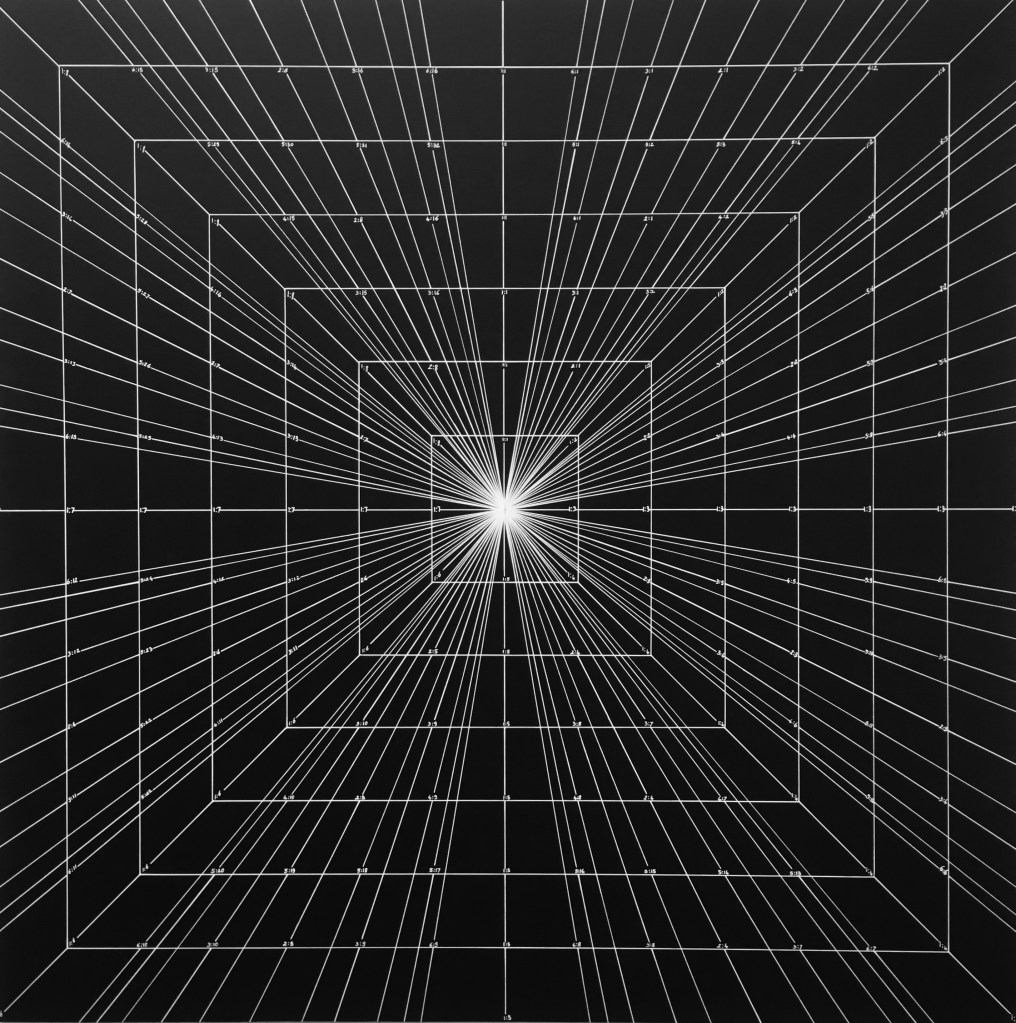


The navigation board has 96 directions in space:
At any given time (from the clock on the wall) the roll of a die determines the direction D(x:y) of the participant’s trajectory, represented by the elastic band, as well as its length Lz in space. The 6-sided die gives the 1st coordinate of the direction. It locates the square the participant will position themselves on: 1 means the 1st square from original location (0), 6 is the 6th square from (0). That square will be where the 2nd coordinate is defined, which will in turn determine the precise direction of the participant’s trajectory.
1- To start with, choose your starting point on the grid and document it by writing ‘0’ next to your chosen nail on the grid. Enter your name, as well as the time (from the clock) and date of your participation in one of the squares around your chosen point of reference.
2- Throw the 6-sided die to move to your square
3- Choose your next die accordingly for the next coordinate:
- Looking at the navigation board, the first and the second square have 8 possible different directions each. The participant will therefore use the 8-sided die if on these squares. The numbers from 1 to 8 will give the 2nd coordinate on the designated square, which will define the trajectory of the elastic band from the original location.
- On the third, fourth and sixth square, there are 16 possible new directions. The participant will therefore use a 16-sided die. The numbers from 1 to 16 will give them the 2nd coordinate on their designated square, which in turn will define their trajectory.
- On the fifth square, there are 32 possible new directions. The participant will therefore use the 32-sided die. The numbers from 1 to 32 will give them the 2nd coordinate on the designated square.
For example as see above, D(4:3) at 4h35: ‘4’ indicates that the participant drew 4 with the 6-sided die. They will start on the 4th square from their initial location 0 and will use the 16-sided die to find out their position on that square. The 16-sided die drew ‘3’. ‘3’ indicates the orientation of the trajectory, from the original location on the grid 0, to the top right corner of the fourth square.
4- Throw the 20-sided die to determine the length L of the move.
Note: If the number on the 20-sided die exceeds the number of coordinates available on the grid and the participant reaches the edge of the grid, he or she will need to reverse their course and finish counting the remaining points in the reverse direction of their track.
 Frederique Jones