Knitting with copper
(back)
I am also drawn to materials whose properties allow them to transcend the constraints of time. For instance, copper, despite being classified as a finite ‘non-renewable’ resource, is remarkably ‘highly recyclable’ and ‘the most reusable’ metal, imbuing it with a sense of timelessness. This quality also resonates with the lack of temporal references in the repetitive gestures of knitting, which I incorporated in my work to explore copper’s malleability. As the knitting process is closely linked with soft, organic materials like wool, this preconceived notion might hinder the recognition of copper…


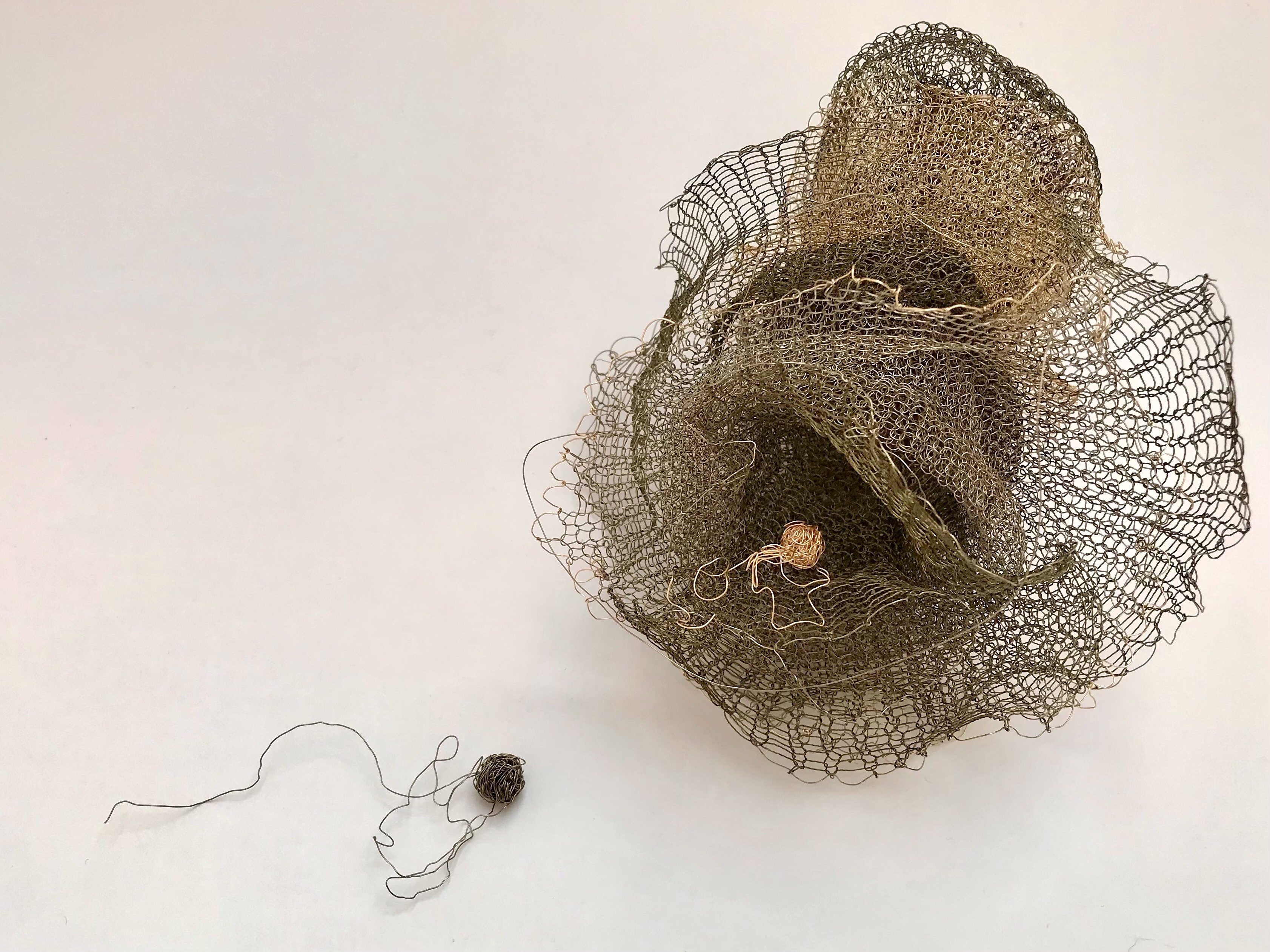
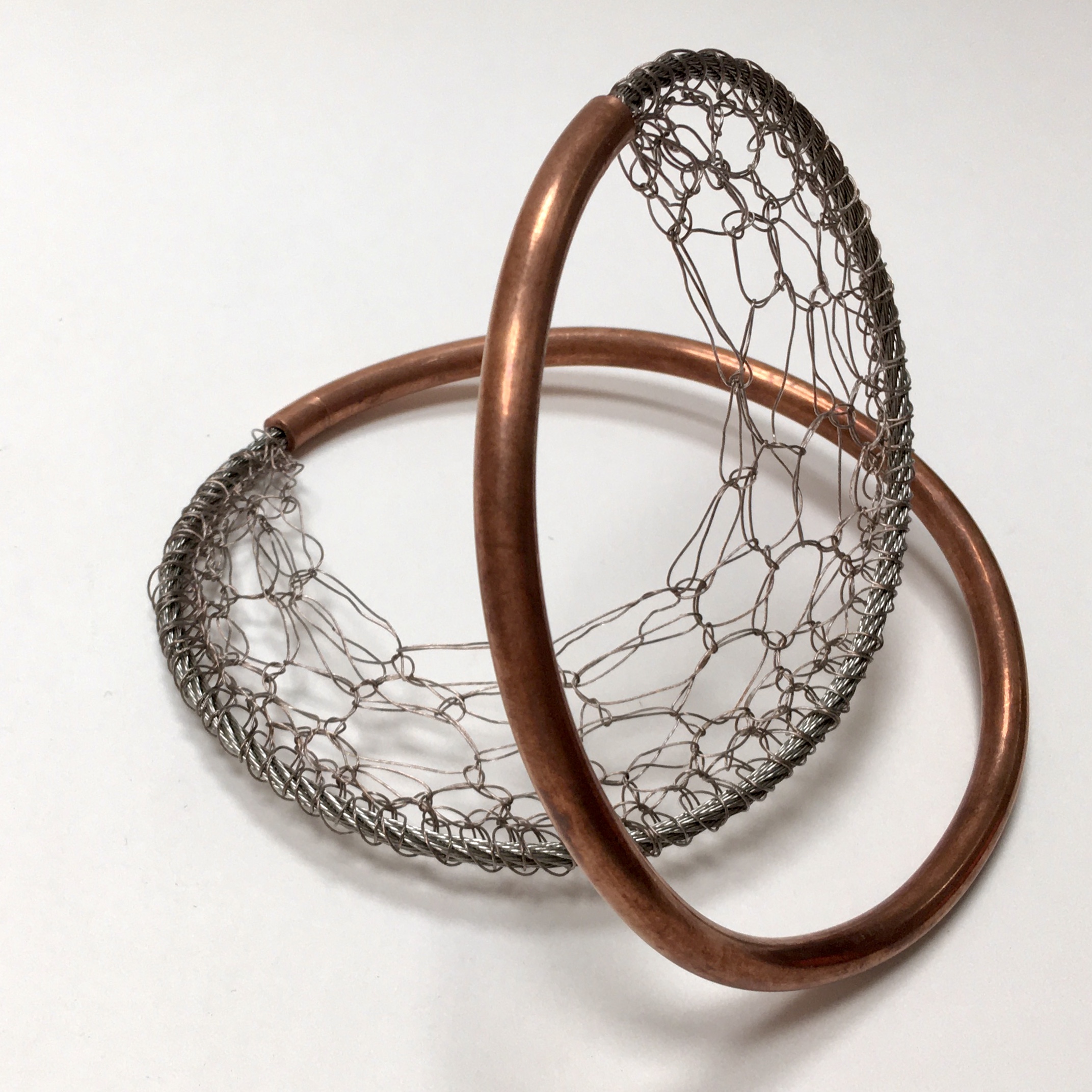
Knitted copper – some observations:
Copper is a stable chemical element (Cu) found pure in nature. It is one of the few metals that can occur in nature in a directly usable form which led to its early human use in several regions, from c. 8000 BC. The applications are very versatile. It is used as a building material for its malleability, ductility, and high thermal and electrical conductivity but also in jewellery to create sterling silver.
Copper’s malleability is made possible by the way its atoms are arranged in a ‘face-centered cubic lattice’. This lattice is in turn made possible from the free ‘delocalised’ electrons of the atoms of copper that are trying to connect with copper ions (positively charged atoms of copper) to neutralise and balance their charges.
Unlike a piece of string, copper is not as fluid and retains the shape of the weave. As a result, over a longer period of time, a series of loops and inter-loops enable the wire to create a plane that can then be modeled into a three dimensional form that can also be reshaped.
Since needle work is traditionally associated with materials such as wool or string, and with activities such as making, mending or decorating (mostly of the cloths category), there is a visual expectation around both the nature of the material and the appearance of a knitted outcome (e.g. a jumper is soft and floppy). The malleability of the copper may mislead the viewer into thinking the material used in the knitting is a conventional knitting material, but the three-dimensional structure disrupts this assumption and encourages the viewer to have a closer look.
As the work progresses, each loop dissects the space into a cell that is almost identical to the previous one and to the next and corresponds to a measurable fraction of the time invested in producing the entire knitted outcome. As time passes, the knitted form becomes a pertinent metaphor for duration where the distinction between past, present and future is blurred by the lack of focal point in the repeated, almost identical loops of the knitted piece.
Copper’s fundamental characteristics also present an exciting temporal symmetry with the process. Despite being a non-renewable resource with a finite existence, copper is also ‘highly recyclable’. It has been used by humans in the same recycled form for the last hundred years. This means that the copper of today is the recycled copper of the past and will be the copper of the future without any distinction of its belonging to past present or future. Additionally, being the first metal that was used by humans from the time of its discovery ten thousands years ago, copper has existed and remained unchanged since the beginning of time, almost as if existing in a permanent ‘now’ and not experiencing the passing of time.
The knitted form is the embodiment of a network of connections with inter-looping itself being a model of interconnection.
More information on copper recycling on this outside link.
 Frederique Jones